In web development, APIs (Application Programming Interfaces) are essential for enabling communication between systems. Developers now have many options when choosing how to build APIs. Let's review the common ones.
The three common API technologies today are REST, GraphQL, and gRPC.
🔹 REST (Representational State Transfer)
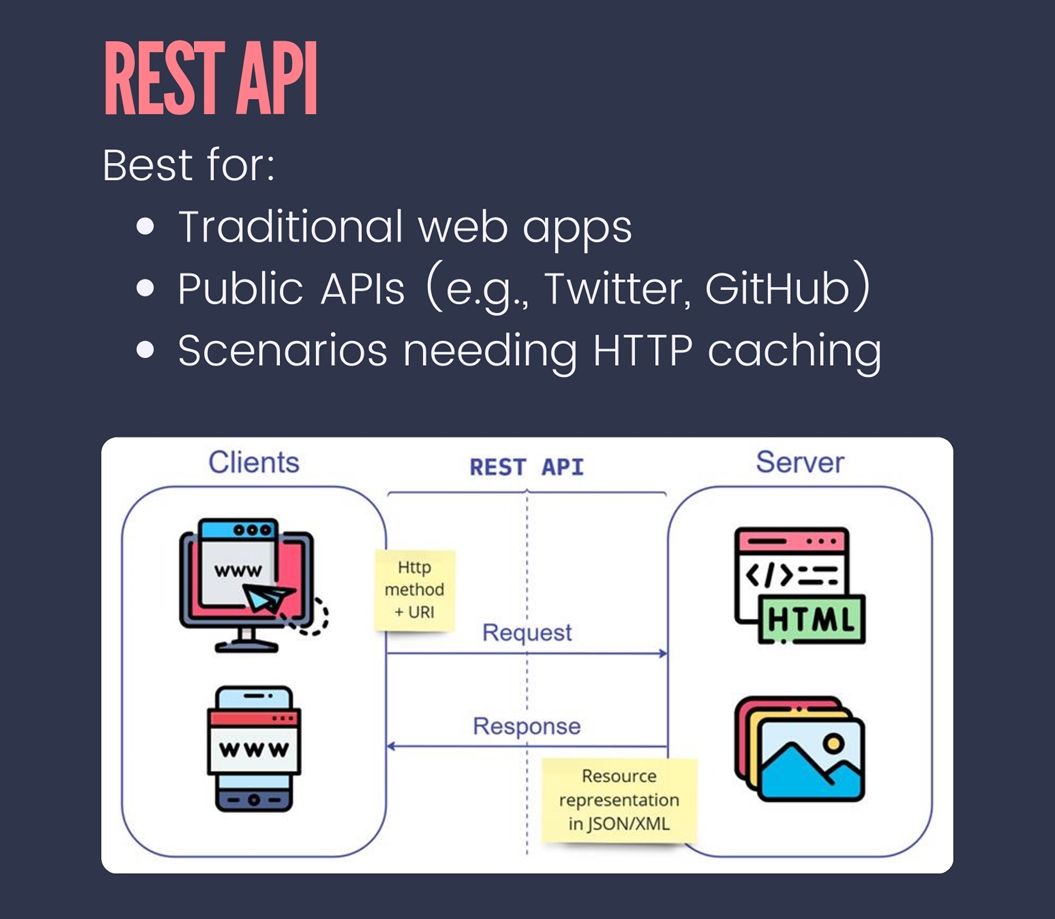
REST is an architectural style widely used for building web applications.
- REST follows a stateless client-server architecture, utilizing principles such as URI, standard HTTP methods, and a representation-oriented approach.
- Responses are typically formatted in JSON or XML.
- REST APIs are highly scalable and leverage HTTP caching mechanisms to enhance performance. Caching reduces server load, significantly boosting overall system efficiency.
- REST APIs enjoy broad support and compatibility with various clients, including web browsers, mobile applications, and backend systems. They integrate seamlessly into existing HTTP infrastructure.
Use Cases:
- Traditional Web Applications
- Public APIs
- Caching Scenarios
🔹 GraphQL
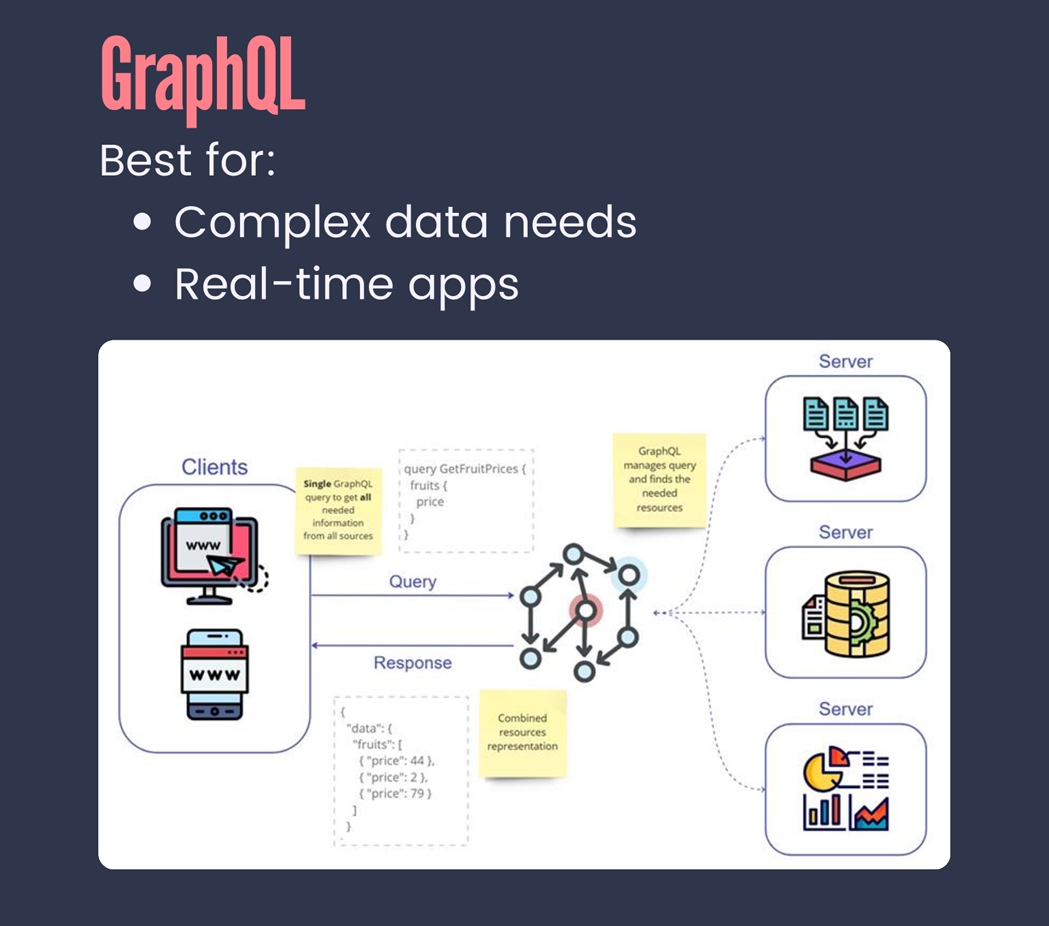
GraphQL, developed by Facebook, is a query language and runtime that offers a flexible, declarative approach to API development.
- GraphQL allows clients to define their exact data requirements, minimizing unnecessary data transfer and enabling efficient, single-request data fetching.
- GraphQL's type system precisely defines available data, ensuring strong typing and automatic request validation. This approach catches errors early in the development process.
- GraphQL returns only the requested fields, optimizing data transfer. This efficiency is especially valuable for scenarios with bandwidth limitations or high latency connections.
- GraphQL supports real-time updates through subscriptions, enabling clients to receive continuous data updates from the server. This makes GraphQL highly suitable for real-time applications like chats or notification services.
Use Cases:
- Complex Data Requirements
- Mobile Applications
- Real-time Updates
🔹 gRPC (Google Remote Procedure Call)
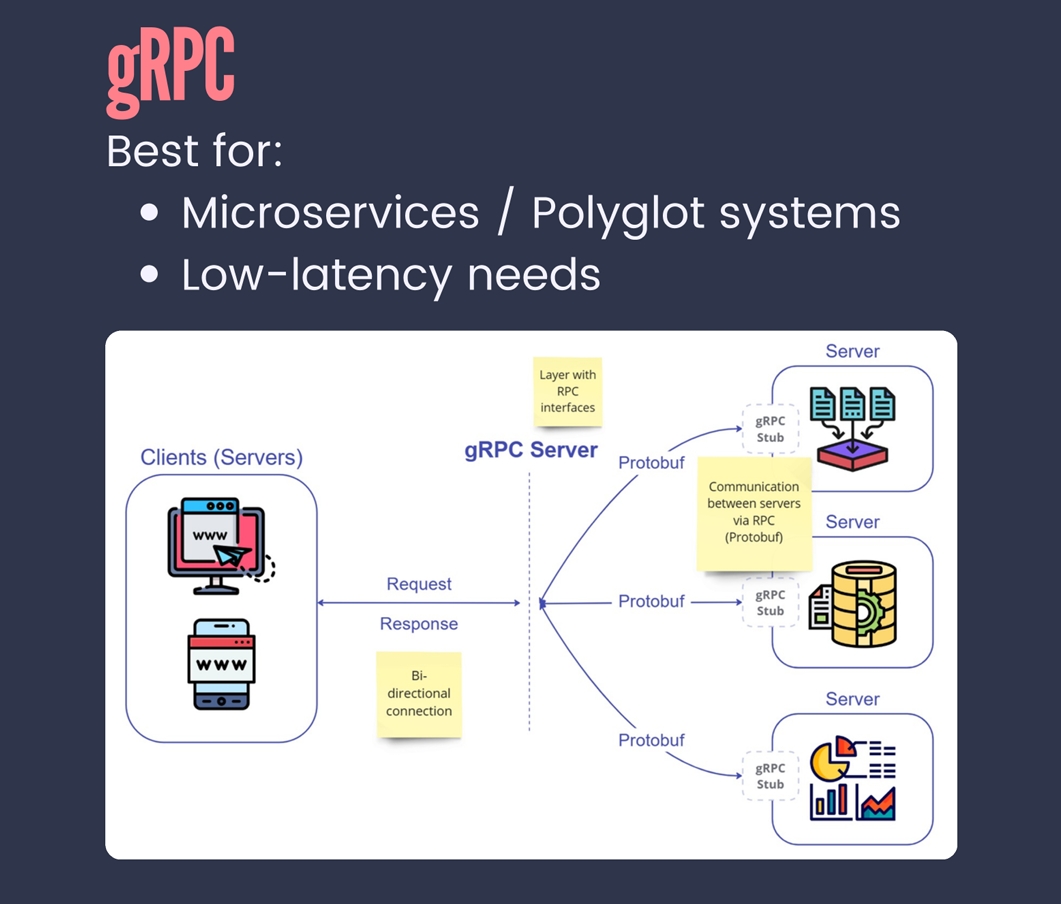
gRPC is an open-source, high-performance framework developed by Google, facilitating efficient service-to-service communication.
- Using Protocol Buffers and binary serialization, gRPC ensures high performance, smaller payload sizes, and rapid serialization/deserialization, outperforming REST and GraphQL in certain scenarios.
- gRPC supports both unidirectional and bidirectional streaming, effectively enabling real-time data exchange.
- Supporting multiple programming languages, gRPC is highly effective for building multilingual systems, automatically generating both client and server-side code in various languages.
- gRPC provides clearly defined error-handling mechanisms and status codes, offering detailed insights into errors, thus enabling efficient debugging and error resolution.
Use Cases:
- Microservices Architecture
- Polyglot Systems
- Low Latency Communication
You can combine these technologies within a single system. For instance, a client might send a GraphQL query, which communicates with REST services that internally leverage gRPC to access resources efficiently.